By HireGPS Editorial | Published June 2, 2026
Reading time: 6 minutes
Contents
- Sending CVs Into the Dark
- What a CV Score Actually Measures
- Deterministic vs Probabilistic Scoring
- The Three Decision Bands and What They Mean
- How to Use a CV Score Iteratively
Sending CVs Into the Dark
For most job seekers, the feedback loop on a CV submission is binary and delayed: either you receive an interview invitation or you receive a polite rejection, often weeks after applying. Between the moment you click send and the moment you receive a response — if you receive one — your CV enters what might as well be a black box. You do not know whether it was parsed correctly by the applicant tracking system, whether it cleared the first human screen, or which specific element caused it to be set aside. You apply, you wait, and if the answer is no, you rarely learn why.
Understanding what is a CV score is the starting point for breaking this cycle. A CV score applies the same structured assessment a recruiter would form on review before you apply — so that you can identify and address problems before they cost you a shortlist slot rather than discovering them in hindsight, after the rejection.
What a CV Score Actually Measures
Beyond Keyword Matching
Many candidates are familiar with ATS scoring tools — Jobscan is the most widely used — which measure the keyword overlap between a CV and a job description. These tools are useful for what they do: ensuring that the language in your CV aligns with the language the ATS will search for. Keyword alignment is a genuine first filter, and passing it matters.
But keyword overlap is one of several filters a CV must pass, and it is not the most differentiating one at the human review stage. A recruiter-grade CV score asks a different question entirely: does the evidence in this CV convince a human reviewer? That question cannot be answered by checking whether “stakeholder management” appears in both documents. It requires evaluating whether the candidate’s achievement bullets contain credible, measurable evidence — and whether the career trajectory, tenure pattern, and seniority signals communicate the right picture for this role.
The Eight Dimensions of a Recruiter-Grade Score
A comprehensive CV score evaluates the document across eight dimensions: Role & Skill Relevance, Seniority Match, Achievement Evidence, Career Stability, Education & Certification Fit, Language & Market Fit, Context & Scale Match, and CV Clarity. Together, these eight dimensions produce a score that reflects how a recruiter would read the CV, not just how an ATS algorithm would parse it.
Deterministic vs Probabilistic Scoring
A CV scoring system that produces different results when the same CV is submitted twice cannot serve as a reliable revision instrument. If a candidate rewrites their achievement bullets, resubmits their CV, and receives a different score, they cannot determine whether the change occurred because the revision was effective or because the scoring system generated a different output from natural variation. This is a fundamental limitation of AI tools that use large language models — probabilistic systems that sample from a distribution and produce varying outputs even with identical inputs.
Deterministic scoring solves this directly. A deterministic system applies a fixed rule set to the CV and returns the same score every time that CV is submitted. This consistency is the precondition for iterative improvement: submit, identify risks, make targeted changes, resubmit, observe the change. If the score does not move after a revision, the revision did not address the flagged risk. If it does move, you have direct evidence that the change was effective. The NIST AI Risk Management Framework identifies consistency and reproducibility as core requirements for trustworthy AI systems in consequential decisions — and a scoring system that affects employment outcomes sits squarely in that category.
⚡ Key insight: A deterministic scoring system returns the same result for the same CV every time. When your score changes after a revision, it is because your CV changed — not because the system generated a different response. This is what makes iterative improvement measurable rather than guesswork.
The Three Decision Bands and What They Mean
CV scoring systems that map scores to decision bands reflect the way recruiting decisions are actually made. Shortlist (72 and above) means the CV is strong enough to present to a hiring manager with confidence. The evidence is credible, the trajectory is coherent, the risk profile is clean. In this band, the score is not the constraint — interview invitations should follow from well-targeted applications.
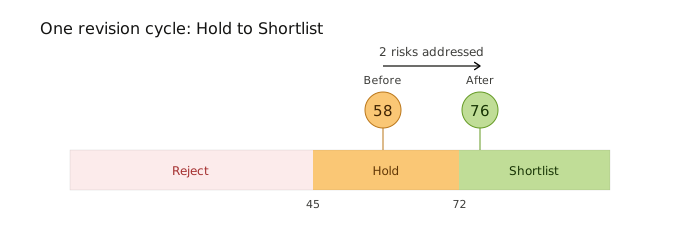
Hold (45–71) is the most instructive band, and the one where most active job seekers sit. The CV has cleared the qualification threshold — the recruiter sees enough to set the CV aside for a closer look rather than declining immediately — but there are evidence gaps or risk signals that prevent confident shortlisting. A candidate in this band is typically qualified for the role but not competitive with their current CV presentation. The good news about Hold is that it is the band where targeted improvement has the highest return: identifying and addressing two or three specific risks often moves a score from 58 to 76 in a single revision cycle.
Band reference: Shortlist (72+) — strong enough to present to a hiring manager; targeting is your focus. Hold (45–71) — qualified but not competitive; address active risks before applying further. Reject (below 45) — fundamental mismatch or widespread risk signals; diagnose the root cause before continuing.
Reject (below 45) usually reflects a fundamental mismatch — wrong function, wrong level, wrong sector — or a CV so risk-laden that even a skilled recruiter cannot construct a presentable case. In this band, the most useful output is the risk breakdown, which clarifies whether the issue is a targeting problem (apply to different roles) or a content problem (address specific gaps before applying further).
How to Use a CV Score Iteratively
The workflow that extracts the most value from a CV score is not a single submission. It is a revision cycle. Submit the current CV. Read the risk breakdown before looking at the overall number — the risks are the diagnosis; the score is the summary. Identify the two highest-severity risks. Make targeted changes to address them specifically. Resubmit and compare the before-and-after scores.
Consider a candidate in the Hold band at 58. Her two active risks are Achievement Evidence Gap (HIGH) and Career Stability Concern (HIGH). She rewrites four duty-based bullets across her two most recent roles — replacing responsibility descriptions with specific, quantified outcomes. She adds a parenthetical tenure label to a 13-month engagement that reads ambiguously without context: “(12-month fixed-term contract).” She resubmits. Her score moves to 76 — Shortlist band. The underlying career history has not changed. The evidence that was always there is now visible and legible to a recruiter reading at pace.
⚡ The revision cycle: Submit → read the risk breakdown → address the two highest-severity risks → resubmit → compare scores. Each cycle produces a measurable, attributable result. Stop when you reach the Shortlist band or all HIGH-severity risks are resolved.
This is what a CV score is designed to enable: not a one-time rating that tells you whether your CV is good or bad, but a feedback instrument that identifies the specific friction points between your current CV and a shortlist outcome, and allows you to measure the effect of addressing them before the application reaches a recruiter’s desk.
Read next:
- Free Resume Score Checker: What It Should Tell You
- A Real HireGPS Analysis: Score 63, Three Risks, Next Steps
HireGPS scores CVs across all eight of these dimensions using a deterministic rule set — the same CV receives the same score every time, so changes produce measurable, reproducible results rather than noise. The risk breakdown shows which specific categories are pulling your score down and what to address first.
Analyse your CV free at hiregps.app and see your recruiter-grade score, active risks, and ranked actions in under a minute.