By HireGPS Editorial | Published June 2, 2026
Reading time: 7 minutes
Contents
- The First Thing Most Candidates Notice
- Alex Carter’s Full Score Breakdown
- The Three Active Risks
- The Ranked Action List
- What This Analysis Reveals That Generic Feedback Cannot
The First Thing Most Candidates Notice
Most candidates, on receiving a HireGPS analysis example for the first time, experience a version of the same recognition: they submit what feels like a strong CV, and the score comes back lower than expected. The gap between self-assessment and independent scoring is not a technical quirk — it is familiarity bias. You know what your CV means because you wrote it and because you know the career behind it. The analysis reads only what is present on the page.
This walkthrough uses Alex Carter, a realistic composite of the type of candidate who uses HireGPS most often. Seven years in product management. A credible track record in UK fintech. Applying for a Senior Product Manager role at a payments company scaling into the consumer market. His overall score was 63 — Hold band. Not a rejection, but not a shortlist. Here is what the analysis showed, and what he needed to do with it.
Alex Carter’s Full Score Breakdown
Category Scores at a Glance
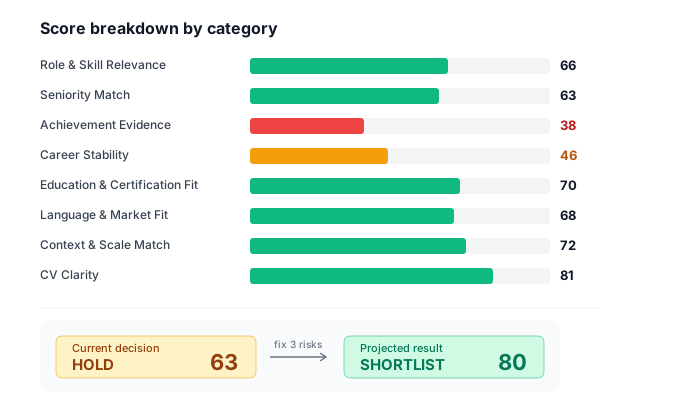
HireGPS evaluates every CV across eight weighted categories. Alex’s results were: Role & Skill Relevance 66, Seniority Match 63, Achievement Evidence 38, Career Stability 46, Context & Scale Match 72, CV Clarity 81, Language & Market Fit 68, Education & Certification Fit 70. Overall score: 63.
⚡ Score context: Two categories — Achievement Evidence (38) and Career Stability (46) — are the constraint. The remaining six are adequate. This is the pattern a deterministic analysis makes visible: not “your CV needs work,” but “these two specific dimensions are below threshold.”
Two categories are pulling the composite score materially below the Shortlist threshold of 72: Achievement Evidence at 38 and Career Stability at 46. These are the categories where active risks have been flagged. The remaining six categories are adequate — some stronger than others — but they cannot compensate for two dimensions sitting well below threshold.
What 63 Means in Practice
Hold means the CV has cleared the qualification gate. Role relevance, sector fit, and career trajectory are credible enough that a recruiter pauses rather than rejects outright. But the evidence quality and risk profile are insufficient to shortlist with confidence. In practice, a Hold candidate may sit in a recruiter’s reviewed pile but is unlikely to be invited to interview unless higher-scoring candidates decline or the pipeline runs thin.
The 63 is not a verdict — it is a specific, actionable diagnosis. Two named risks are responsible for the gap between the current score and the Shortlist band. Addressing them is a targeted task, not a wholesale CV rewrite.
Remember: The score is not a verdict. It is a specific, actionable diagnosis. Named risks identify exactly what is pulling the score down — addressing them is a targeted task with a quantifiable recovery, not a general improvement exercise.
The Three Active Risks
Achievement Evidence Gap — HIGH
Trigger condition: three or more role entries contain bullets that describe responsibilities rather than outcomes. The analysis detected that five of Alex’s eight bullets across his two most recent roles were duty-based — they described what he was assigned to do, not what happened as a result.
The specific bullet that fired this risk: “Led cross-functional product teams to deliver multiple initiatives across the card issuance journey.” This is a sentence that appears, in some variation, on thousands of product manager CVs. “Led cross-functional teams” implies nothing about scope. “Multiple initiatives” is undefined. “Card issuance journey” names a process, not an outcome. A recruiter cannot assess impact from this sentence.
Suggested rewrite: “Led four cross-functional squads across engineering, design, and data to launch a card issuance feature adopted by 68,000 users within 90 days, reducing onboarding drop-off by 22 percentage points and contributing an estimated £1.4M in annualised net revenue.” The underlying fact — the feature launched, users adopted it, attrition fell — was already true. The rewrite changes the framing, not the record.
Career Stability Concern — HIGH
Trigger condition: two roles in the preceding 25 months, each under 18 months’ duration, with no contextual labels explaining the short tenure. Alex’s CV showed: NovaPay, Product Manager, 11 months; Payzap, Lead Product Manager, 14 months. Neither entry carried a label such as “contract,” “fixed-term,” or “role eliminated — company restructure.”
To a recruiter scanning at pace, this pattern raises a specific concern: did this candidate leave voluntarily under ambiguous circumstances, or were they asked to leave? The actual explanation for both tenures was entirely legitimate — Payzap was a 12-month contract engagement; NovaPay underwent a structural reorganisation that eliminated Alex’s role in March 2025. But the CV, as written, required the recruiter to guess rather than read.
Suggested fix: add parenthetical labels — “(12-month contract)” to Payzap, and “(role eliminated — company restructure, March 2025)” to NovaPay. Two bracketed phrases resolve a HIGH-severity risk at no cost to truthfulness. This is among the most recoverable risk categories because the fix requires no substantial content change, only contextualisation.
Role Relevance Partial — MODERATE
Trigger condition: the target role specifies “B2C product experience” as a requirement. Three of Alex’s four role summaries reference enterprise clients, B2B card programmes, or SME payment solutions. No bullet references consumer-facing scale, consumer product metrics, or direct-to-consumer user research.
This risk is flagged as MODERATE rather than HIGH because fintech payment experience is genuinely relevant — the mismatch is domain-specific, not a full category miss. The suggested action is to identify any consumer-facing metric or product outcome in the career history and surface it explicitly, and to update the personal statement to acknowledge the B2C application directly. Leaving the gap unaddressed means the recruiter has to infer relevance; making it explicit moves the burden back to the analysis, where it belongs.
The Ranked Action List
The analysis returns four actions ordered by estimated score recovery potential. This ordering matters because most candidates do not have unlimited revision time — the ranking directs effort toward the changes that move the score most efficiently.
Action 1: Rewrite three duty-based bullets across the two most recent roles with quantified outcomes. Estimated score recovery: +8 points. This is the highest-priority action because Achievement Evidence is both the lowest-scoring individual category and carries significant weight in the composite score. A 38 in this dimension is a major drag on the overall result.
Action 2: Add contextual labels to both short-tenure roles. Estimated score recovery: +5 points. Career Stability currently sits at 46 — well inside the risk zone. Two parenthetical notes resolve the ambiguity that is generating the flag. This is the second priority because it is also among the fastest actions to execute.
Action 3: Insert a revenue or business-impact statement into each of the two most recent roles. Estimated score recovery: +4 points. This addresses Achievement Evidence and partially addresses Role Relevance simultaneously, creating compound benefit from a single effort.
Action 4: Update the personal statement to reference consumer product interest and cross-functional team scale. Estimated score recovery: +2 points. Useful, but lower-priority — address after the first three.
⚡ Pro tip: Address the highest-recovery action first, then resubmit before tackling the next. Isolating changes to one risk at a time lets you measure the exact score movement from each revision — so you know what worked and can stop when you reach the Shortlist band.
Estimated overall score after the top three actions are implemented: 80. That moves Alex from Hold (63) to Shortlist (72 and above) with meaningful headroom. The three actions — rewriting bullets, adding tenure labels, and inserting impact statements — are achievable in a focused two-to-three hour revision session.
What This Analysis Reveals That Generic Feedback Cannot
Generic CV feedback — from a career coach, a recruiter who offers an informal review, or a broad scoring tool — produces directional advice. “Your bullets need to be more achievement-focused” is correct and also insufficiently specific to act on efficiently. It does not name which bullets triggered the flag, explain the precise condition that fired the risk, or estimate the score recovery available from addressing it.
The analysis described above named the specific bullet responsible for the Achievement Evidence Gap, explained the trigger condition, showed the rewrite, and quantified the recovery. That specificity is what converts a general critique into a concrete task. Alex did not leave his revision session wondering what to do. He knew which three bullets to rewrite, why the tenure labels were necessary, and what score he would reach after addressing the top three items.
A score of 63 in a deterministic scoring system means something precise: these two categories are the constraint, these three actions address them, and this is the score that results from addressing them. That is the analysis functioning as intended — not as a rating, but as a diagnostic instrument.
Read next:
- What Is a CV Score? The Complete Guide for Job Seekers
- Free Resume Score Checker: What It Should Tell You
Every element of this walkthrough — the eight category scores, the named risks, the ranked action list — reflects the actual output structure of a HireGPS analysis. The fictional candidate is composite; the risk names, band thresholds, and scoring framework are live.
See how a recruiter would score your CV at hiregps.app — free, deterministic, and explained.