By HireGPS Editorial | Published June 2, 2026
Reading time: 8 minutes
Contents
- Forty Applications, Zero Callbacks
- What Most Free Resume Score Checkers Actually Test
- What a Genuine Recruiter-Grade Score Checker Does Differently
- How to Interpret Your Score
- Getting Maximum Value From a Free Score Check
Forty Applications, Zero Callbacks
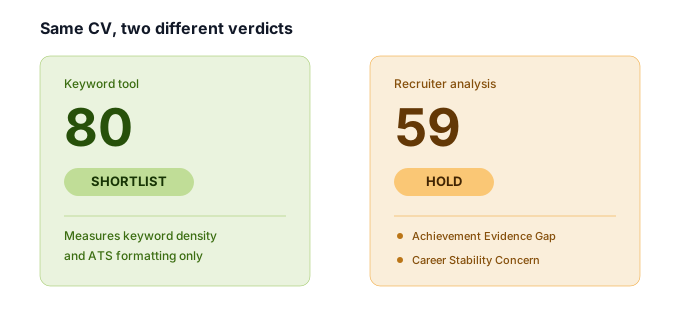
Priya Mehta applied to forty roles over three months. She had updated her CV, run it through two free resume score checker tools, and scored above 80 on both. Not one application produced a phone screen. When she submitted the same CV through a recruiter-grade analysis platform, her score was 59 — Hold band. Two HIGH-severity risks were flagged: Achievement Evidence Gap and Career Stability Concern. Neither had been detected by the tools that rated her at 80.
The disconnect is not accidental. The tools that scored her CV at 80 were measuring something real — keyword alignment between her CV and the job descriptions she submitted against. They did it accurately. The problem is that keyword alignment is one filter, not the only filter, and the filter Priya was failing was the one those tools do not cover: the human recruiter review. Understanding the difference between a keyword score and a genuine free resume score checker is what determines whether the feedback you receive before applying is actually useful.
What Most Free Resume Score Checkers Actually Test
The free score checker market is dominated by tools built on a single mechanism: keyword overlap. The tool extracts the key terms from a job description — “stakeholder management,” “project delivery,” “agile methodology,” “budget ownership” — and checks whether those same terms appear in your CV. If they match, your score rises. If they are absent, it falls. A score of 80 means that 80% of the key terms identified in the job description appear somewhere in your CV text.
This is a legitimate measurement. Applicant tracking systems — the software used by most large employers to handle initial application screening — operate on broadly similar keyword and criteria logic. A CV that fails to use the language of its target role genuinely risks being filtered out before a human sees it. Tools that measure keyword alignment are solving a real problem, and Jobscan, the most established of these tools, does it well.
The problem is scope, not accuracy. Keyword alignment tools measure what they measure and nothing else. They cannot assess whether the keywords are supported by credible evidence. A CV that lists “P&L ownership” in a skills section but contains no bullet demonstrating revenue accountability will score well on keyword overlap and fail on achievement evidence quality — a distinction that is invisible to the keyword tool but immediately apparent to a recruiter. Similarly, a CV with two unexplained 11-month tenures in the past two years scores identically to one with stable 3-year tenures on a keyword check, even though the tenure pattern is one of the most reliable risk signals in recruiter screening.
Priya’s CVs scored at 80 because they contained the right words in the right proportion. They scored at 59 on a recruiter-grade analysis because three of her last five bullets described responsibilities without outcomes, and two short tenures were presented without contextual explanation. The first set of tools could not see those problems because they were not designed to look for them.
Case study: Priya scored 80+ on two keyword tools. Her recruiter-grade score was 59. Both results were accurate — they measured different things. Keyword tools assessed vocabulary alignment. The recruiter analysis found an Achievement Evidence Gap and a Career Stability Concern that keyword matching cannot detect.
What a Genuine Recruiter-Grade Score Checker Does Differently
Eight Categories, Not One
A genuine recruiter-grade score checker evaluates the CV across multiple dimensions simultaneously. Rather than asking “does this word appear?”, it asks whether the CV provides credible evidence across the dimensions a recruiter actually evaluates. Those are fundamentally different questions, and they produce fundamentally different feedback.
The eight categories that a comprehensive CV score covers are: Role & Skill Relevance, Seniority Match, Achievement Evidence, Career Stability, Education & Certification Fit, Language & Market Fit, Context & Scale Match, and CV Clarity. Each of these corresponds to a genuine recruiter concern that keyword overlap cannot detect.
Deterministic Output
A CV score is only useful as a revision instrument if it is consistent. Tools that use probabilistic AI models — generating feedback through a language model that samples from a distribution — produce different outputs when the same CV is submitted twice. This is not a flaw in any specific tool; it is a property of the underlying technology. The practical consequence is that you cannot reliably measure whether a revision improved your score or whether the score simply varied between runs.
A deterministic scoring system applies the same fixed rules to every submission and returns the same result every time. When your score changes after a revision, it is because your CV changed — not because the system generated a different response. This consistency is the foundation of iterative improvement: submit, identify the specific risks, make targeted changes, resubmit, observe the exact score movement. Each revision cycle produces measurable, attributable feedback.
Named Risks, Not Just a Number
A score without an explanation is informative but not actionable. Knowing your CV scores 59 tells you that work is needed. Knowing that your CV has an active Achievement Evidence Gap risk — triggered because four of your last six bullets describe responsibilities without quantified outcomes — tells you exactly which bullets to rewrite and in what direction. The difference between a number and a named, ranked risk breakdown is the difference between “your CV needs improvement” and a specific, ordered task list.
The most useful score checkers produce both: the overall score that situates you relative to the Shortlist threshold, and the specific risks that explain the gap. Addressing named risks is a concrete, finite task. Trying to improve a number without knowing what is causing it is not.
How to Interpret Your Score
Shortlist — 72 and Above
A Shortlist score means the CV is strong enough to present to a hiring manager. The evidence is credible, the trajectory coherent, the risk profile clean. Candidates in this band who are not receiving interview responses should examine targeting (are they applying to roles that genuinely match their background?) and application volume (are they applying to enough well-matched roles?), rather than CV quality. The score is not their bottleneck.
Hold — 45 to 71
Hold is where the majority of active job seekers sit, and it is the band where targeted improvement has the highest return. The CV has cleared the threshold for recruiter attention — there is enough there to not reject outright — but evidence gaps or risk signals are preventing confident shortlisting. Two or three targeted changes routinely move a Hold score into Shortlist territory. Priya’s experience illustrates this: she moved from 59 to 74 after rewriting four duty-based bullets with specific, quantified outcomes and adding a contextual label to a 13-month engagement that read ambiguously without it. Those two changes — the most significant being the bullet rewrites — required approximately two hours of focused revision and changed her call-back rate in the following month.
If you are in the Hold band, the first action is to read the risk breakdown rather than the score. The risks tell you which categories are pulling you below 72 and what specifically to address. The overall number is the summary; the risks are the diagnostic.
⚡ Band summary: Shortlist (72+): CV is strong enough to present to a hiring manager — targeting and volume are your bottleneck, not CV quality. Hold (45–71): qualified but not competitive with current presentation — two or three targeted changes typically reach Shortlist. Reject (below 45): fundamental mismatch or widespread risk signals — diagnose before applying further.
Reject — Below 45
A Reject score usually reflects a fundamental mismatch — wrong function, wrong level, wrong sector — or a CV with severe, widespread risk signals: multiple unexplained gaps, no evidence of achievement across any role, a seniority level that bears no relationship to the target role’s requirements. The risk breakdown at this score is most useful for clarifying whether the issue is targeting (apply to different roles that match your actual profile) or content (address critical gaps before applying further). Submitting to more roles with an unresolved Reject-band CV produces more rejections, not better outcomes.
Getting Maximum Value From a Free Score Check
The candidates who get the most from a free score check follow a specific workflow. First, submit your CV against a realistic, representative role — not your aspirational dream role, but a role you are actively targeting and for which you meet the stated requirements. The more accurate the role context, the more precise the relevance-based scoring will be.
Second, read the risk breakdown before you read the overall score. The score is the summary; the risks are the diagnosis. A score of 63 tells you “this needs work.” An Achievement Evidence Gap (HIGH) and a Career Stability Concern (HIGH) tell you exactly what kind of work and where. The natural impulse is to look at the number first — resist it.
⚡ Pro tip: The score tells you how far you are from Shortlist. The risks tell you exactly why — and which specific changes will close the gap most efficiently. Read the risk breakdown first, every time.
Third, address one risk at a time and resubmit before moving to the next. This is more efficient than it sounds. Addressing an Achievement Evidence Gap means identifying three to five specific bullets that describe responsibilities and rewriting them to describe outcomes — a focused 60-to-90-minute task. Resubmitting after that single change lets you observe precisely how much score recovery that action produced, which calibrates the effort you should invest in subsequent revisions.
Fourth, continue the cycle until you reach the Shortlist band or until all HIGH-severity risks are resolved. At that point, the remaining marginal gains from MODERATE-risk changes require more effort per score point recovered. Apply once the highest-leverage changes are done, not before.
Priya’s three-month callback drought ended in the first week after she addressed her two flagged risks. The revision took less time than writing the fortieth generic application. That is the value a genuine free score check is designed to deliver — not a confidence score to reassure you that your CV is fine, but a specific, honest account of where it falls short of the Shortlist threshold and exactly what to do about it.
Read next:
- What Is a CV Score? The Complete Guide for Job Seekers
- ATS Screening vs Recruiter Review: Why You Need to Pass Both
HireGPS is built on exactly this model — eight category scores, named risks ranked by severity, and a deterministic rule set that produces the same output for the same input every time. The first 3 analyses are free every week — no account required, and the risk breakdown is included in the free result.
Run your CV analysis free at hiregps.app — your score, your risks, and exactly what to fix before you apply.