By HireGPS Editorial | Published June 2, 2026
Reading time: 10 minutes
Contents
- What Jobscan Does — and Does It Well
- Where Jobscan Stops
- The Filter Jobscan Does Not Cover
- HireGPS as a Jobscan Alternative — or Complement
- Five Dimensions Compared
- When to Use Which Tool
What Jobscan Does — and Does It Well
Jobscan is the most capable ATS keyword optimisation tool available to job seekers. That is not a qualified compliment — it is an accurate description of the product’s position in its category. The tool analyses a CV against a specific job description, identifies the keywords and phrases present in the description but absent from the CV, and produces a match score and an actionable list of terms to incorporate. It does this accurately, at speed, and with a level of sophistication that reflects genuine investment in understanding how ATS platforms operate.
Jobscan’s research team has done meaningful work on ATS parsing mechanics — how different platforms handle formatting, which file types preserve structured data most reliably, and which keyword forms are recognised as equivalent by different systems. Their hard skills and soft skills matching, job title optimisation, and section-by-section analysis are genuinely useful features. For candidates applying to large organisations with sophisticated ATS infrastructure, this type of optimisation is not optional — it is the price of entry.
If you are looking for a Jobscan alternative because you want better ATS keyword optimisation, you are unlikely to find one that does the same job more effectively. Jobscan’s limitation is not quality within its scope. Its limitation is scope.
On Jobscan: It is the most capable ATS keyword tool available to job seekers. The limitation is not quality — it is scope. Jobscan solves the ATS filter problem. It does not solve the recruiter filter problem.
Where Jobscan Stops
Jobscan measures the presence of keywords and criteria in a CV relative to a job description. It does not — and does not claim to — evaluate the quality of the evidence behind those keywords. A CV that includes “stakeholder management” as a line in its skills section scores identically on keyword overlap to a CV that demonstrates stakeholder management through a specific bullet: “Managed relationships with 14 C-suite stakeholders across three business units, consolidating quarterly reporting from six separate processes into a single board-ready format.” Both CVs pass the keyword filter. One is a more persuasive document.
Similarly, Jobscan cannot assess career stability risk. A CV with two 10-month tenures in the past two years, both unlabelled, will score the same keyword percentage as one with 3-year tenures — because the keyword matching mechanism has no visibility into tenure patterns, risk signals, or career narrative coherence. It scores vocabulary, not credibility.
Jobscan also does not evaluate seniority signals. A candidate applying for a Director role whose CV contains no budget figures, no team size references, and no stakeholder seniority indicators will receive the same keyword match score as a candidate whose CV is rich with these signals — because the job description’s keywords typically do not include “I need to see a budget figure” or “demonstrate your team size.” Those seniority signals are inferred by a recruiter, not extracted by an ATS.
None of this is a critique of Jobscan. It is a description of what ATS keyword optimisation is and is not. Jobscan solves the ATS filter problem. It does not solve the recruiter filter problem. Most candidates who are struggling with their job search have a problem with one or both of these filters — and the right tool depends on which filter they are failing.
The scope limitation extends to career narrative coherence. A series of lateral moves without evident rationale — moving between sectors, function-hopping without clear progression, or returning to a previous employer level after a gap — are invisible to a keyword tool because career narrative is not a keyword. A recruiter reading those moves will ask why they happened. The ATS will not. Candidates with complex career histories — sector changes, international moves, function pivots — have a narrative coherence problem that vocabulary optimisation will not solve, regardless of how many more points their keyword score accrues.
⚡ What keyword tools cannot assess: Evidence quality behind keywords. Career stability risk. Seniority signals (budget scale, team size, stakeholder level). Career narrative coherence. These are the dimensions a recruiter evaluates at the human review stage — and they are invisible to ATS keyword analysis.
The Filter Jobscan Does Not Cover
After a CV passes ATS screening, it reaches a human reviewer. At large organisations this is an in-house recruiter; at smaller ones it may be the hiring manager directly. Research from TheLadders’ eye-tracking study (2012) found that recruiters spend an average of six to seven seconds on their initial CV review — a first pass that assesses structural signals before the recruiter decides whether to read further.
That initial assessment is not about keywords. It is about whether the CV looks right for this level of role: does the career history show upward progression? Does the most recent title and employer create a credible first impression? Are there visible indicators of achievement scope? And then, in the more deliberate second pass: are there quantified, specific outcomes? Are there risk signals — unexplained gaps, short tenures without context, lateral moves without rationale — that would require awkward explanation to a hiring manager?
These are the dimensions the recruiter filter assesses. They are invisible to keyword optimisation tools because they are not about vocabulary — they are about evidence, narrative coherence, and risk profile. A candidate with an 80% Jobscan match and a recruiter-grade score of 52 (Hold band) is a real and common pattern. The keyword score tells them their ATS performance is strong. The recruiter score tells them where they are actually losing shortlist opportunities.
The recruiter filter is, in many ways, the more important one to address, particularly for mid-to-senior career candidates. Research from LinkedIn Talent Solutions suggests that ATS filtering is proportionally less significant at senior levels, where role volumes are lower, pipelines are more often managed manually, and recruiter judgment carries more weight relative to automated screening. At the director and above level, the human review is frequently the primary filter, making recruiter-grade quality assessment more critical than ATS optimisation.
HireGPS as a Jobscan Alternative — or Complement
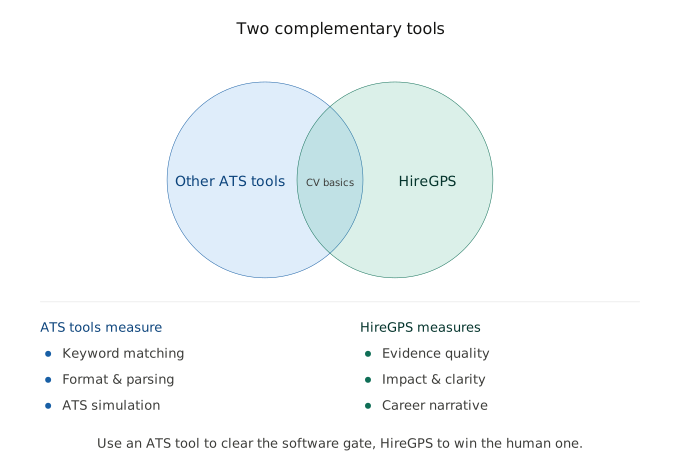
HireGPS and Jobscan are not alternatives in the sense of doing the same job. They answer different questions. Jobscan answers: “Does my CV contain the vocabulary the ATS is searching for?” HireGPS answers: “Does my CV provide the quality of evidence a recruiter would need to shortlist me with confidence?” These are two genuinely distinct questions, and the answers to both matter.
HireGPS evaluates CVs across eight categories using a deterministic rule set: Role & Skill Relevance, Seniority Match, Achievement Evidence, Career Stability, Education & Certification Fit, Language & Market Fit, Context & Scale Match, and CV Clarity. The scoring model identifies the specific risks active in the CV — named risk categories like Achievement Evidence Gap, Career Stability Concern, and Seniority Mismatch — and returns them ranked by severity and estimated score recovery potential. The output is a recruiter-logic quality assessment, not a keyword analysis.
The deterministic approach matters specifically because it enables iterative improvement. When a candidate addresses a specific risk and resubmits their CV, the score change reflects the CV change — not model variation. A HireGPS score of 54 that becomes 72 after three specific revisions is evidence that those revisions were effective. This reproducibility is the basis of a revision workflow rather than a one-time snapshot.
For candidates who need both tools — which is most active job seekers — the workflow is sequential: use HireGPS first to establish recruiter-grade quality, address the highest-severity risks, reach the Shortlist band, and then use Jobscan to align the vocabulary of your now-strong CV to specific job descriptions. This order matters because the changes that improve recruiter quality (rewriting duty bullets, adding seniority signals, contextualising tenures) are more demanding than keyword substitutions. Building on a credible evidential foundation produces better results than applying keyword optimisation to a structurally weak document.
Five Dimensions Compared
ATS optimisation is Jobscan’s core strength and is not HireGPS’s focus. Jobscan analyses keyword overlap with precision, identifies missing hard and soft skills, and flags formatting issues that impair ATS parsing. HireGPS does not attempt to replicate this — it evaluates the quality of the evidence the CV contains, not its vocabulary alignment with a specific job description. Use Jobscan for ATS optimisation; use HireGPS for recruiter-level quality.
Recruiter-level scoring is HireGPS’s focus and Jobscan’s explicit out-of-scope. HireGPS evaluates achievement evidence quality, seniority signals, career stability risk, trajectory coherence, and the other dimensions a human reviewer assesses — none of which keyword tools can measure. Candidates who are passing ATS and failing human review need recruiter-level scoring, not more keyword alignment.
Consistency is a meaningful differentiator for revision purposes. HireGPS’s scoring is deterministic — the same CV receives the same score every time, making score changes directly attributable to CV changes. Jobscan’s keyword match percentage is also deterministic within its scope: the same CV against the same job description produces the same keyword score. Both tools are consistent in their respective domains.
Explainability differs in character. Jobscan explains which keywords are present and which are missing, with suggestions for incorporating absent terms. HireGPS explains which risk categories are active and why — “Achievement Evidence Gap because three of your last five bullets describe responsibilities without outcomes” — and what to do about it. Both are actionable; they explain different things.
Pricing at the time of writing: Jobscan offers a free tier with limited scans and paid plans starting from approximately $49 per month for full functionality. HireGPS offers 3 free analyses per week — no credit card required; premium plans are priced at $12.99 per month or $89 per year for up to 10 analyses per 30-day window. For candidates conducting a focused, targeted job search rather than high-volume applications, the cost-per-useful-analysis comparison generally favours starting with the free tiers of both tools.
When to Use Which Tool
⚡ Rule of thumb: Early-career: start with Jobscan (ATS filtering is the primary barrier). Mid-career and above: start with HireGPS (recruiter quality is the primary constraint). Already scoring 75%+ on Jobscan but not getting callbacks: the ATS filter is not your problem.
Early-career candidates who have never run their CV through an ATS optimisation tool: start with Jobscan. At the early-career level, ATS filtering is the primary barrier because many large graduate employers use ATS platforms at scale. Getting your vocabulary right before your career history is deep enough to be assessed on evidence quality is a reasonable priority.
Mid-career candidates with three or more years of experience who are applying and not receiving responses: start with HireGPS. The most common cause of no-callback at the mid-career level is not keyword mismatch — it is evidence quality, risk signals, and seniority misalignment. These are recruiter-filter problems, not ATS problems. A recruiter-grade assessment will identify the constraint more accurately than additional keyword work.
Senior and executive candidates at director level and above: prioritise HireGPS. At senior levels, ATS filtering is proportionally less significant because role volumes are lower and human judgment carries more weight. The constraint is almost always the quality of evidence — whether the CV demonstrates the seniority, impact scale, and leadership scope the role requires. Keyword optimisation is a refinement at this level, not a primary lever.
Active job seekers applying at scale to a specific role category: use both, in sequence. HireGPS first to establish recruiter-grade quality and reach the Shortlist band. Jobscan next, applied per-application to align vocabulary to specific job descriptions. This is the combination that addresses both filters systematically rather than relying on one to carry the whole weight of an application.
For candidates who have already run their CV through Jobscan multiple times and are still not receiving responses, the most likely explanation is that the ATS filter is no longer the primary constraint. At 75% keyword match and above, the ATS filter is largely satisfied for most role types. What is failing is the recruiter filter — and addressing it requires a different type of assessment entirely. Continuing to increase keyword density past the point of reasonable alignment produces diminishing ATS returns and does nothing to address the evidence quality, seniority signals, and risk flags that determine shortlisting at the human review stage.
Candidates preparing for a specific high-priority application — a role at a company they particularly want to join, a level they have not yet reached, or a sector they are trying to enter — benefit most from the combined approach executed with care. HireGPS first, to identify the structural quality level and the active risks. Revision to address those risks. Then Jobscan’s role-specific optimisation to align the vocabulary of an already-strong CV precisely to that specific posting. This sequence maximises performance at both filters for the applications that matter most, rather than applying generic optimisation broadly.
Read next:
- ATS Screening vs Recruiter Review: Why You Need to Pass Both
- Free Resume Score Checker: What It Should Tell You
HireGPS was built to cover the filter that keyword tools do not — the human recruiter review that determines shortlisting decisions. It evaluates the same dimensions a recruiter evaluates, using the same logic, and returns a score and risk breakdown that explains exactly what a recruiter would flag. Used alongside a keyword tool, it addresses both filters rather than one.
See how a recruiter would score your CV at hiregps.app — free, deterministic, and explained.