By HireGPS Editorial | Published June 2, 2026
Reading time: 7 minutes
Contents
- The Gap Between ATS Optimisation and Interview Invitations
- What ATS Screening Actually Evaluates
- What Human Recruiter Review Evaluates
- Why the Same CV Can Score 78% on Jobscan and 54 on a Recruiter Analysis
- How to Optimise for Both Without Competing Priorities
The Gap Between ATS Optimisation and Interview Invitations
A recognisable pattern emerges in job search forums regularly: a candidate reports running their CV through Jobscan, achieving a keyword match score of 75 to 85 percent, applying to dozens of roles, and receiving no interview invitations. The response from the community is usually to optimise further — add more keywords, adjust formatting, increase the density of role-specific terminology. More optimisation produces the same result.
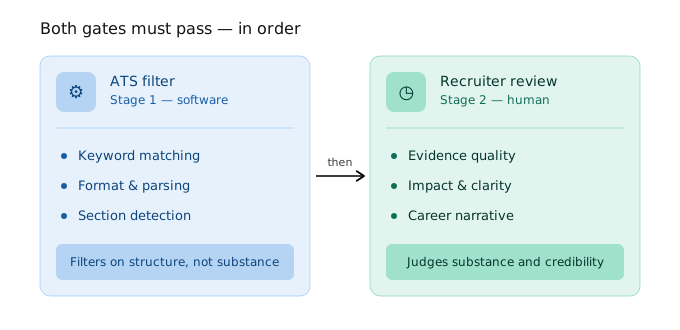
The explanation lies in the ATS screening vs recruiter distinction that most CV advice collapses into a single process. ATS screening and recruiter review are two separate filters with different mechanics, different evaluation criteria, and different implications for what your CV needs to demonstrate. Passing one does not guarantee passing the other. Candidates who address only one filter and treat it as sufficient are optimising for half the problem.
What ATS Screening Actually Evaluates
Applicant Tracking Systems are database management tools with screening logic, not intelligent evaluators. Their core function is to filter a high-volume application pool down to a manageable set for human review, based on predefined criteria. Those criteria typically include keyword presence (does the CV contain the specific terms specified in the job description or the ATS configuration?), threshold criteria (does the candidate meet minimum requirements for years of experience, listed qualifications, or education level?), and format parseability (can the system correctly extract information from the document structure?).
The keyword matching component is what tools like Jobscan measure and optimise for. This is useful because ATS systems do filter on keyword presence, and a CV that omits the specific language of its target role risks being screened out before a human sees it. LinkedIn Talent Solutions’ recruiter behaviour research suggests that a significant proportion of applications are filtered at the ATS stage in high-volume environments, though the exact proportion varies considerably by organisation, role level, and sector.
Critically, ATS systems do not evaluate the quality of evidence behind the keywords they match. A CV that lists “stakeholder management” in a skills section with no supporting bullet evidence scores identically to a CV that demonstrates stakeholder management through a specific, outcome-oriented example. Both CVs pass the ATS filter. Only one will survive the recruiter review that follows.
⚡ Key distinction: ATS systems filter on the presence of keywords. Recruiters evaluate the quality of evidence behind them. A CV can pass one filter and fail the other — and most candidates who are stuck in their search are failing the second filter, not the first.
The format parseability dimension is also worth understanding specifically, because it is the source of the widely-repeated advice to avoid tables, multi-column layouts, text boxes, and embedded graphics in CVs submitted to large employers. ATS platforms extract information by parsing a document’s text structure, and complex layouts frequently cause extraction errors — a role title may be parsed as the company name, dates may be misread, or entire sections may fail to extract. A CV with sophisticated visual design may parse as a near-empty document in the ATS, receiving the lowest possible keyword score regardless of its content quality. Plain text formatting with conventional section headers is ATS-safe; anything more architecturally complex introduces parsing risk that no amount of keyword optimisation can compensate for.
What Human Recruiter Review Evaluates
Once a CV passes ATS screening, it reaches a human reviewer — typically an in-house recruiter or a recruitment consultant — who is conducting a different type of assessment entirely. TheLadders’ eye-tracking study (2012) found that experienced recruiters spend an average of six to seven seconds on initial CV review, establishing a first impression before deciding whether to read further. That impression is formed not from keyword counts but from structural signals: the most recent title, the employer name, the date sequence, and the presence or absence of visible evidence of achievement.
The human review evaluates achievement evidence quality: are there specific, quantifiable outcomes in the CV, or only responsibility descriptions? It evaluates career trajectory: does the history show upward progression in scope and accountability? It assesses seniority signals: are there budget figures, team sizes, or stakeholder seniority references that communicate the candidate’s level independently of their title? And it scans for risk signals: unexplained short tenures, significant gaps, lateral moves without evident rationale. None of these dimensions are visible to an ATS.
This is the evaluation that determines shortlisting. A CV with excellent keyword alignment but no quantified achievements, a 10-month tenure without contextual explanation, and no visible seniority signals will pass the ATS and fail the recruiter review. The recruiter’s concerns are not addressed by keyword optimisation.
Why the Same CV Can Score 78% on Jobscan and 54 on a Recruiter Analysis
Marcus Webb is a mid-level project manager with six years’ experience across infrastructure and digital transformation. He submitted his CV through Jobscan against a Senior Project Manager role at a utilities company and received a keyword match score of 78%. He then submitted the same CV through a recruiter-grade analysis platform and received a score of 54 — Hold band.
The discrepancy had three sources. First, Achievement Evidence Gap: of Marcus’s eleven bullets across his three most recent roles, nine described responsibilities. “Managed project timelines and stakeholder communications across multiple workstreams” appears as a bullet in his current role. The ATS detected “managed,” “project,” “stakeholder,” and “workstreams” — all present in the job description. The recruiter analysis detected that the bullet offered no evidence of what happened: whether timelines were met, what scale the workstreams operated at, or what the stakeholder outcomes were.
Second, Career Stability Concern: Marcus held a role for 10 months in 2022 with no contextual label. The ATS has no mechanism to flag this pattern. The recruiter analysis identified it as a HIGH-severity risk because the absence of explanation creates ambiguity about whether the departure was voluntary.
Third, Seniority Match weakness: the target role required “P&L oversight” and “team leadership of 10+.” Marcus’s CV contained neither a budget figure nor a team size across any role. The role description’s keywords did not include “budget” prominently, so the keyword gap did not appear in his Jobscan score. But the absence of these seniority signals meant his CV communicated a level below the role’s requirements to a human reviewer.
The 78% keyword score and the 54 recruiter score are both accurate measurements. They are measuring different things.
78% ATS match. 54 recruiter score. Both numbers are accurate. The ATS checked vocabulary. The recruiter analysis checked evidence quality, seniority signals, and career stability. This discrepancy is common — and it explains why keyword optimisation alone does not translate into interview callbacks.
How to Optimise for Both Without Competing Priorities
ATS optimisation and recruiter-level quality are not competing priorities — they are sequential ones. The optimal approach is to address recruiter-level quality first, then layer keyword alignment on top. This sequencing matters because the changes that improve recruiter quality (adding quantified outcomes, inserting seniority signals, contextualising short tenures) are substantive content changes that take time. Keyword alignment is a faster, targeted vocabulary exercise that can be applied to already-strong content.
Start with a recruiter-grade assessment of your current CV. Identify the active risks — the specific evidence gaps, trajectory signals, and risk flags that a recruiter would flag in the first human review. Address the highest-severity risks first, which typically means rewriting duty-based bullets to demonstrate outcomes, adding seniority scope indicators (budget, team size, stakeholder level), and contextualising any tenure anomalies.
Once the recruiter-level quality is strong, run a keyword alignment check against your target role description. The vocabulary adjustments at this stage are refinements to already-credible content — ensuring that the language you use matches the language the ATS is searching for, without reducing the specificity of your evidence. A bullet that already describes a specific, quantified outcome can almost always be reworded to include the role’s exact terminology without sacrificing its evidentiary value.
The candidate who emerges from this sequential process has a CV that passes both filters. They do not have a CV optimised for one at the expense of the other.
⚡ Sequencing matters: Recruiter-quality first, keyword alignment second. The content changes that fix evidence gaps and seniority signals are more demanding than vocabulary adjustments — and they produce a stronger foundation to build keyword optimisation on top of.
There is a useful way to frame the relationship between the two filters. ATS screening is the gate to the door; recruiter review is the door itself. Candidates who cannot pass the gate do not reach the door. But a candidate who dedicates all their effort to the gate — pushing their keyword match score to 90% — and arrives at the door with a CV that contains no quantified evidence of achievement, unexplained short tenures, and no seniority signals, will be declined at the door regardless. Both filters need to pass. The order of priority depends on which one you are currently failing, and knowing the difference between them is the starting point for working that out.
Read next:
- Free Resume Score Checker: What It Should Tell You
- Jobscan Alternative: What HireGPS Does That Jobscan Doesn’t
HireGPS addresses the recruiter-review filter specifically — it is not an ATS keyword tool, and it is designed to be used alongside one, not instead of one. The analysis identifies the evidence gaps, seniority signal weaknesses, and risk flags that keyword optimisation cannot detect.
Analyse your CV free at hiregps.app and see your recruiter-grade score, active risks, and ranked actions in under a minute.